
Look Back in Anger
by John Osborne
Directed by John Edmunds
November 23rd - 28th and November 30th - December 4th, 2004
The Tower Theatre performing at the Lion and Unicorn Theatre, Kentish Town

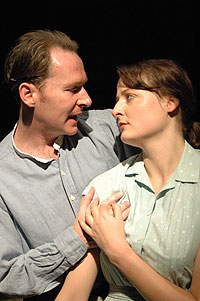

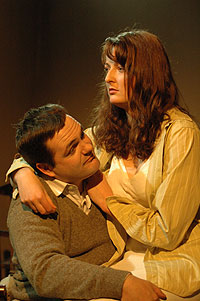
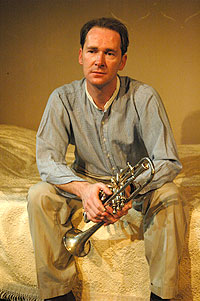
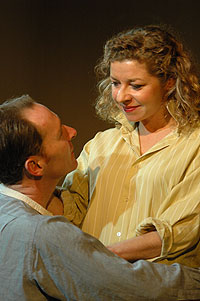
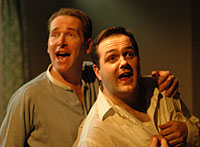

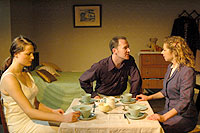
Cast List
Jimmy Porter : Jeffrey Smith
Cliff Lewis : Martin Mulgrew
Alison Porter : Amy Simpson
Helena Charles : Julie Arrowsmith
Colonel Redfern : Robert Pennant Jones
Production Team
Director : John Edmunds
Set Design : Wendy Parry
Lighting and Sound Design : Laurence Tuerk
Costume Design : Linda Stewart-Birch
Stage Manager : Richard Pedersen
DSM : Dinah Irvine
Lighting operator : Lucy Danser
Sound operators : Jonathan Norris, Chris Peregrine
Trumpet played by Richard Willis
Set construction : Keith Syrett, Matthew Vickers, Alan McKenzie & cast and crew
Costume assistant : Suzanne Day
Review by Richard Hodkinson in the Camden New Journal
Of all the plays, of all the areas of the theatrical canon in fact, that should be approached with caution by
amateur companies, John Osborne's archetypal kitchen sink drama Look Back in Anger would have to be top
of the pile.
The directness of the text and the raw manifestations of emotion make tremendous demands on actors, and the play's
events seem recognisably contemporary to a 21st century audience (Osborne wrote the play in 1956).
In short, the play leaves the cast and their director nowhere to hide. There is no flamboyant prose, no archaic
illusions, hammy conversations, distracting costumes or tricksy sets to divert the eye from any shortcomings.
Osborne demanded theatre in the raw - something amateur companies are usually incapable of delivering.
The Tower Theatre Company has developed a justifiable reputation as one of the best am-dram outfits in the capital,
however, and their approach to this most challenging work demonstrates why.
They are courageous to tackle Osborne head-on, as he needs to be, and deliver an ensemble performance strong enough
to generate au unfolding sense of horror as the central protagonists draw each other towards mutually assured
destruction.
Jimmy Porter, the angriest of the angry young men of British theatre in the 1950's and 1960's is locked in
unsatisfactory marriage with Alison, a well-bred young woman who will not rise to his incessant taunting.
Like a tongue that cannot help playing over a broken tooth, Jimmy needles Alison and their lodger, the amiable
Cliff, obsessively, as means of venting his frustration and self-loathing.
Alison is rescued from this brutalising relationship by Helena, who then begins another doomed relationship
with Jimmy. What motivates these strongly drawn but ambiguous characters is a point of endless debate among
Osborne aficionados but the cast of this production have found a compelling, unfussy interpretation of a
psychologically complex text. The cast of five works well as an ensemble, as it must, and benefits from
John Edmunds' admirably straightforward direction.
Particularly good is Julie Arrowsmith as Helena, but Martin Mulgrew as Cliff and Amy Simpson as
Alison both present robust and convincing performances too. Jeffrey Smith chooses to play Jimmy as slightly camp,
which means that his character falls short of being the nihilistic dynamo of Osborne's imagination.
That said, the scene in which he makes his venomous assertion that Alison should have a child only so she
can watch it die, one of the most powerful in 20th-century British theatre, is disturbingly effective.
This is as strong a production of challenging material as I can remember from a non-professional company, and
strong enough to recommend even to those unfamiliar with the play.
Look Back in Anger
by John Osborne |
|
|
November 23rd - 28th and November 30th - December 4th, 2004 |
The Tower Theatre performing at the Lion and Unicorn Theatre, Kentish Town |
|
|
|
|
|
|
|
|
|
|
Cast List
|
Production Team
|
Review by Richard Hodkinson in the Camden New Journal
Of all the plays, of all the areas of the theatrical canon in fact, that should be approached with caution by
amateur companies, John Osborne's archetypal kitchen sink drama Look Back in Anger would have to be top
of the pile.
The directness of the text and the raw manifestations of emotion make tremendous demands on actors, and the play's
events seem recognisably contemporary to a 21st century audience (Osborne wrote the play in 1956).
In short, the play leaves the cast and their director nowhere to hide. There is no flamboyant prose, no archaic
illusions, hammy conversations, distracting costumes or tricksy sets to divert the eye from any shortcomings.
Osborne demanded theatre in the raw - something amateur companies are usually incapable of delivering.
The Tower Theatre Company has developed a justifiable reputation as one of the best am-dram outfits in the capital,
however, and their approach to this most challenging work demonstrates why.
They are courageous to tackle Osborne head-on, as he needs to be, and deliver an ensemble performance strong enough
to generate au unfolding sense of horror as the central protagonists draw each other towards mutually assured
destruction.
Jimmy Porter, the angriest of the angry young men of British theatre in the 1950's and 1960's is locked in
unsatisfactory marriage with Alison, a well-bred young woman who will not rise to his incessant taunting.
Like a tongue that cannot help playing over a broken tooth, Jimmy needles Alison and their lodger, the amiable
Cliff, obsessively, as means of venting his frustration and self-loathing.
Alison is rescued from this brutalising relationship by Helena, who then begins another doomed relationship
with Jimmy. What motivates these strongly drawn but ambiguous characters is a point of endless debate among
Osborne aficionados but the cast of this production have found a compelling, unfussy interpretation of a
psychologically complex text. The cast of five works well as an ensemble, as it must, and benefits from
John Edmunds' admirably straightforward direction.
Particularly good is Julie Arrowsmith as Helena, but Martin Mulgrew as Cliff and Amy Simpson as
Alison both present robust and convincing performances too. Jeffrey Smith chooses to play Jimmy as slightly camp,
which means that his character falls short of being the nihilistic dynamo of Osborne's imagination.
That said, the scene in which he makes his venomous assertion that Alison should have a child only so she
can watch it die, one of the most powerful in 20th-century British theatre, is disturbingly effective.
This is as strong a production of challenging material as I can remember from a non-professional company, and
strong enough to recommend even to those unfamiliar with the play.