
Accidental Death of an Anarchist
by Dario Fo
Directed by Pat Grosse
15th - 19th June, 2004
The Tower Theatre performing at Theatro Technis, Camden

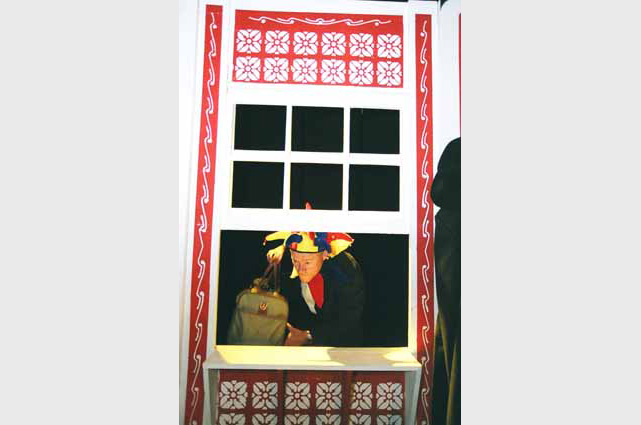


Cast List
Maniac : Michael Greener
Bertozzo : Martin Mulgrew
Constable : Tracey Kent
Inspector : Richard Watkins
Superintendent : Chris Peregrine
Journalist : Moragh Gee
Production Team
Director : Pat Grosse
Set Design : Rebecca Vincent
Lighting Design : Andy Peregrine
Costume Design : Nigel Martin
Sound Design : Simon Humphries
Stage Manager : Phyllis Spencer
ASMs : Sandra Yee, Ros Moore, Andy Hind, Alison Liney
Lighting operators : Linky Trott, Jacky Devitt
Sound operator : Martin Brady
Wardrobe : Celia Reynolds, Nigel Martin & members of the cast
Set construction : Keith Syrett, Keith Hill & members of the cast and crew
Review by Colin Smith
Dario Fo came to the fore by upsetting successive Italian governments considerably. His plays - more than 40 of them, though few are known here - combine popular farce and
savage political comment. Now he is in his eighties, but one wonders what satiric gems he might have conjured up to challenge the tragi-comedy of the current Berlusconi regime. His comic treatment
of corrupt government mirrors the somewhat ambiguous attitude of the Italian public - part shoulder-shrugging, part enraged to the extent that leads them to drive past the homes of leading political
offenders for the express purpose of flinging contemptuous handfuls of small change at their front doors.
All sadly unlike the home life of our own dear politicians ... Here, Fo's best-known play is probably Accidental Death. Written in 1970, it is based on the actual demise of one
Guiseppe Pinelli, an anarchist railway worker who "accidentally" fell from the window of a Milan police station during interrogation - a situation rich in satiric possibilities.
How effectively may such a situation be transferred to another country? In the U.K. we are certainly no strangers to dubious deaths in custody, but then our response to corruption in
general is hardly as volatile. I seem to remember that the translation used in the original English production was more intense and politically loaded, whereas Simon Nye's very free
version settles largely for knockabout comedy.
But Dario Fo is no master craftsman of farce and the limping moments need special attention. In making pace alone the priority I felt that Pat Grosse's production sometimes lacked coherence.
Much of the import of the opening scene with the arrival of the Maniac was lost on us, being blurred by loud and rapid speech: in the interval I checked this out with my immediate neighbours,
who shared my confusion. The gift of the gab has comic possibilities but needs to be tempered and timed: pace is no substitute for rhythm.
The role of the Maniac is one of apparently uncontrolled energy; and after this initial uncertainty Michael Greener's performance grew convincingly, a prodigious feat of memory, physical energy
and rapid role-changes involving a range of accents. His patrician upper-crust idiom was particularly effective for being underplayed.
In a piece populated by potential grotesques it could be more effective to keep the supporting characters relatively low-key: a plethora of funny voices over-eggs the cake. In particular,
a cod Brummie accent for the Inspector in an otherwise effective performance (Richard Watkins) was just too much. All the cast rallied gamely in ridiculing legal procedures and in trying
to arrive at an agreed version of the facts of the case. Martin Mulgrew as Bertozzo blustered well and Chris Peregrine was an assured Superintendent, but the degree of physical knockabout was overdone and
lacked precision: to be fully effective it does need to be plotted by numbers and rehearsed in scrupulous detail to make its point.
Rebecca Vincent's set design served the production well, though I was puzzled by the leisurely and unexplained change to a house of cards during which the uncredited Juggler manfully continued to sustain
his skills. Lighting, sound and costumes all contributed to the general effect, but overall I had to conclude that a less consistently noisy approach with more focused movement would have added to the
sum of pleasure.
Accidental Death of an Anarchist
by Dario Fo |
|
|
15th - 19th June, 2004 |
The Tower Theatre performing at Theatro Technis, Camden |
|
Cast List
|
Production Team
|
Review by Colin Smith
Dario Fo came to the fore by upsetting successive Italian governments considerably. His plays - more than 40 of them, though few are known here - combine popular farce and
savage political comment. Now he is in his eighties, but one wonders what satiric gems he might have conjured up to challenge the tragi-comedy of the current Berlusconi regime. His comic treatment
of corrupt government mirrors the somewhat ambiguous attitude of the Italian public - part shoulder-shrugging, part enraged to the extent that leads them to drive past the homes of leading political
offenders for the express purpose of flinging contemptuous handfuls of small change at their front doors.
All sadly unlike the home life of our own dear politicians ... Here, Fo's best-known play is probably Accidental Death. Written in 1970, it is based on the actual demise of one
Guiseppe Pinelli, an anarchist railway worker who "accidentally" fell from the window of a Milan police station during interrogation - a situation rich in satiric possibilities.
How effectively may such a situation be transferred to another country? In the U.K. we are certainly no strangers to dubious deaths in custody, but then our response to corruption in
general is hardly as volatile. I seem to remember that the translation used in the original English production was more intense and politically loaded, whereas Simon Nye's very free
version settles largely for knockabout comedy.
But Dario Fo is no master craftsman of farce and the limping moments need special attention. In making pace alone the priority I felt that Pat Grosse's production sometimes lacked coherence.
Much of the import of the opening scene with the arrival of the Maniac was lost on us, being blurred by loud and rapid speech: in the interval I checked this out with my immediate neighbours,
who shared my confusion. The gift of the gab has comic possibilities but needs to be tempered and timed: pace is no substitute for rhythm.
The role of the Maniac is one of apparently uncontrolled energy; and after this initial uncertainty Michael Greener's performance grew convincingly, a prodigious feat of memory, physical energy
and rapid role-changes involving a range of accents. His patrician upper-crust idiom was particularly effective for being underplayed.
In a piece populated by potential grotesques it could be more effective to keep the supporting characters relatively low-key: a plethora of funny voices over-eggs the cake. In particular,
a cod Brummie accent for the Inspector in an otherwise effective performance (Richard Watkins) was just too much. All the cast rallied gamely in ridiculing legal procedures and in trying
to arrive at an agreed version of the facts of the case. Martin Mulgrew as Bertozzo blustered well and Chris Peregrine was an assured Superintendent, but the degree of physical knockabout was overdone and
lacked precision: to be fully effective it does need to be plotted by numbers and rehearsed in scrupulous detail to make its point.
Rebecca Vincent's set design served the production well, though I was puzzled by the leisurely and unexplained change to a house of cards during which the uncredited Juggler manfully continued to sustain
his skills. Lighting, sound and costumes all contributed to the general effect, but overall I had to conclude that a less consistently noisy approach with more focused movement would have added to the
sum of pleasure.