


Three Tall Women
by Edward Albee
Directed by Zizi Sulkin
November 24th - December 1st, 2001
The Tower Theatre Company performing at the Tower Theatre, Canonbury

Cast List
A : Penny Tuerk
B : Annie Connell
C : Meg Meagher
Young Man : Martin Brady
Production Team
Director : Zizi Sulkin
Set Design : Dorothy Wright
Lighting Design : Alan Wilkinson
Stage Manager : Martin Brady
ASM : Tom Brown
Rehearsal prompt : Sue Lacey
Lighting operator : Samantha Gallop
Sound operators : Pat Grosse, Jacqui de Prez
Wardrobe : Kay Perversi, Philippa Pearson
Sound tape : Phillip Ley
Set construction : Ellie Curtis, Ralph Ward, John Sole, Keith Syrett, Phoebe Mortimer, Charlotte Machin, John Morton, Natalie Brereton, Chris Jones,
Roger Beaumont, Phil Ley, Keith Hill, Laurence Tuerk, Robert Myer, Mary Benning & members of the cast and crew
In-house review by Trevor Williams
Trevor Williams has been a member of the Company for
more than 40 years as performer, artistic
director and chairman. As a student at Cambridge
he was a member of the Marlowe Society and the
Footlights.
This was an excellent production of a baffling play. In the
light of it one may ask why does Edward Albee
write plays at all, why did he write this play
and indeed why does he trouble to get out of bed
in the morning and sustain his melancholic
existence with coffee and bagels only to walk to
the typewriter and the lonely angst of
playwriting?
The answer
may be that it is what he does. He is good at it
and just as some musical people become good
musicians and some cunning far-sighted people
become successful businessmen, so Albee has the
intelligence, the observation of conduct and
character and the concision of language to make a
good playwright.
Some vitality
drives him to it. He is no mere cynic. He does
get up and write those plays and bring life
to the theatre, but he is trapped in the
limitations of his own perception. His is a bleak
and mordant talent, which exposes his subjects
without sentiment but also without much
enlightenment. A lesser writer would swathe
Albee's disagreeable topics in emotionalism and a
greater would point the audience at the play's
end to a deeper sympathy with the plight which
Albee draws with such discomforting clarity.
Nevertheless his vigour and descriptive accuracy
always make for a lively theatrical event and
command attention.
Albee's
motive in writing Three Tall Women may have been
personal and related to his own adoptive mother,
but the miseries of old age are certainly a topic
of general public interest to which a playwright
may turn for its own sake. With increasing
longevity, amnesia, dementia paranoia and
physical debility of which Albee draws a harsh
account cloud the final years of many lives.
To this,
however, he has added in full measure what better
or more fortunate old people may still avoid: the
bitterest regrets and recriminations at past
disappointments, unrelieved by any forgiveness or
reconciliation. This final assessment of his
mother's life, upon which he has touched in
earlier work, gives the play an added personal
intensity from which it benefits theatrically but
is also a warning, perhaps unintentional to any
parents or child not to seek independence or
understanding at the price of compassion.
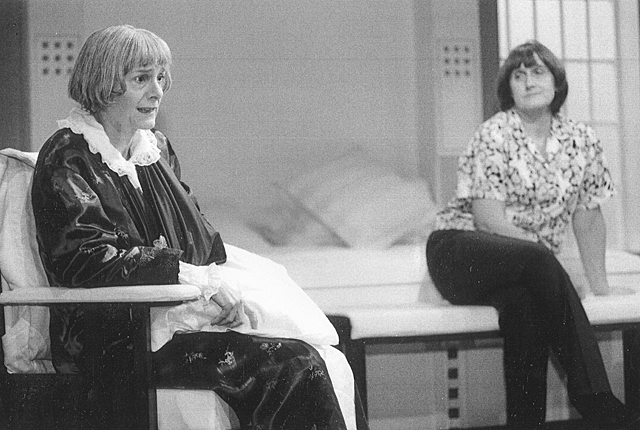
Zizi Sulkin's
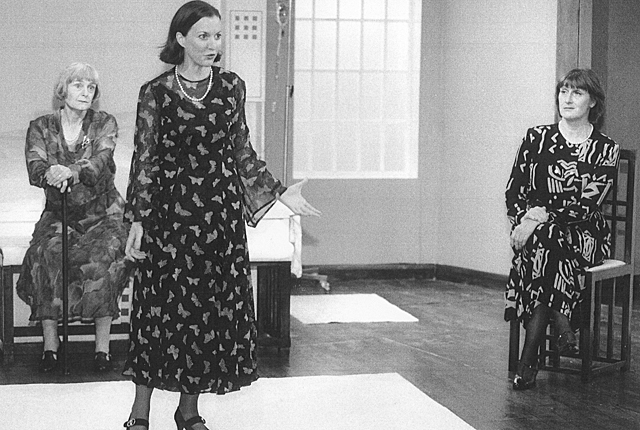
production was stark, and vital. She was well
served by Dorothy Wright's splendid set, cool,
elegant and beautifully furnished and by the
well-chosen costumes and nicely controlled
lighting. The whole presentation enhanced the
objective spirit of the writing and the acting.
The play
offers little scope for physical action and while
the production was static it was best to avoid
the temptation of motiveless movement and to keep
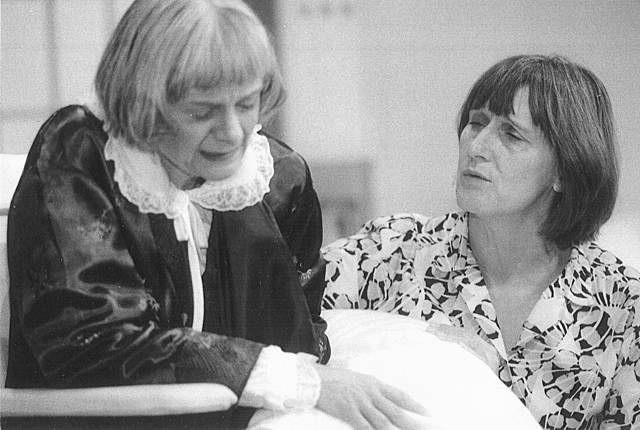
the actors focused on the text. The three actors,
no doubt carefully directed, mastered the text,
bringing to it life, colour and variety, with
many well pointed touches of irony and paradox,
thus retaining interest and sympathy through what
could, in different hands, have been a very drab
evening.
The format of
the play is ingenious but not easy to perform. It
entails women B and C playing two distinct parts
each. In the first more naturalistic Act, Annie
Connell as woman B, the nurse, and Meg Meagher as
woman C, the lawyer, apart from being good
listeners to the monologues of elderly woman A,
drew firm contrasting characters typifying the
resignation of the carers and the disgust off the
occasional visitors at the problem of senility.
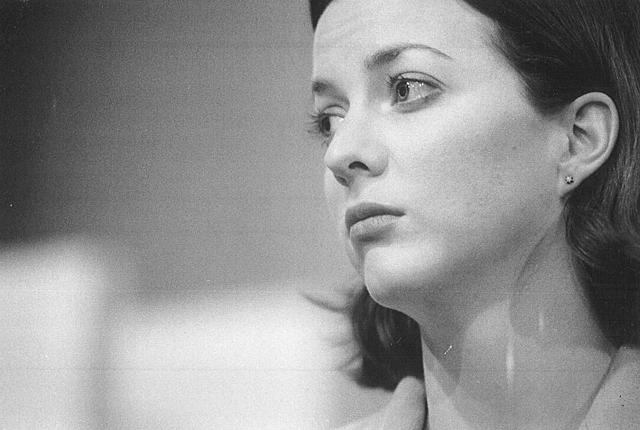
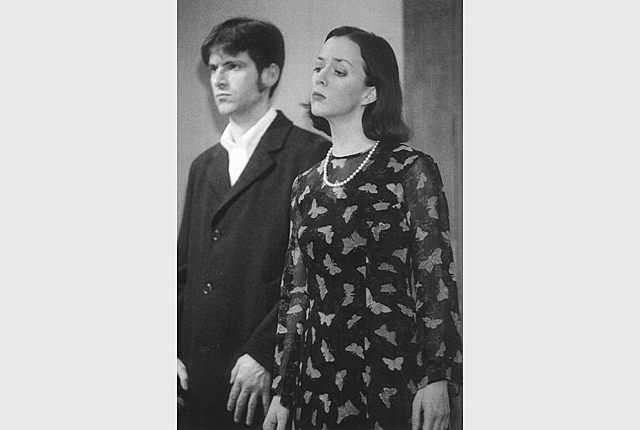
For them
there was the difficult transition to Act II, in
which they were required to play A in her earlier
life, B in her middle age and C in her youth.
Despite clear changes of costume and character,
it took a while to shake off the nurse and the
lawyer, but they achieved it and moved our
interest to the play's main theme, the state of A
and how she came to it.
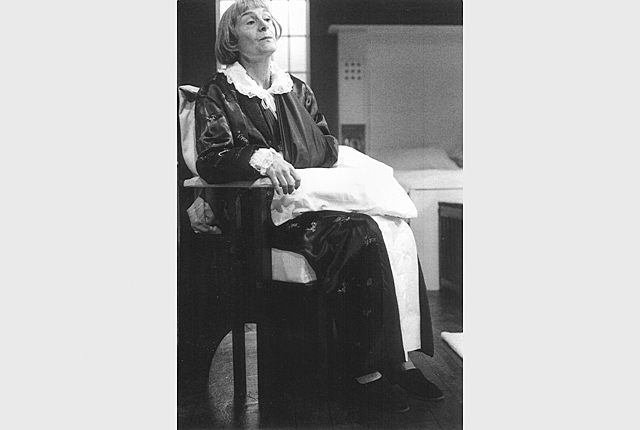
As the
central character, woman A, Penny Tuerk delivered
a tour de force. It is a huge part written within
a restricted dramatic ambience. She played it
with all variety and fluency and spiced it with a
glinting panache which helped make even this grim
play enjoyable.
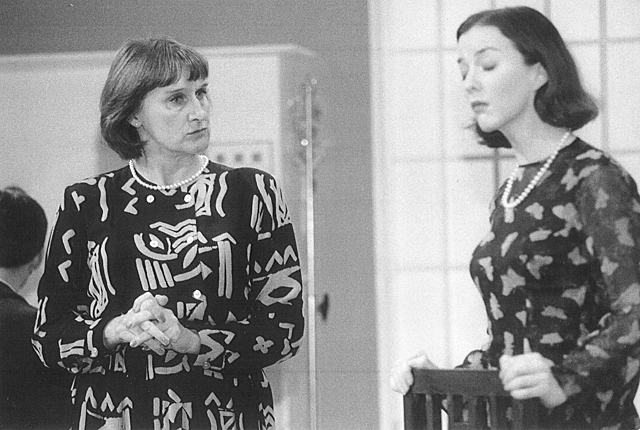
Perhaps the
best feature of a very good production was the
alert co-operation between all three actors. They
and the director had given attention to every
detail and possibility of the script and they
received their reward in a fully satisfied
audience.
Three Tall Women
by Edward Albee |
|
|
November 24th - December 1st, 2001 |
The Tower Theatre Company performing at the Tower Theatre, Canonbury |
|
Cast List
|
Production Team |
In-house review by Trevor Williams
Trevor Williams has been a member of the Company for more than 40 years as performer, artistic director and chairman. As a student at Cambridge he was a member of the Marlowe Society and the Footlights.
This was an excellent production of a baffling play. In the
light of it one may ask why does Edward Albee
write plays at all, why did he write this play
and indeed why does he trouble to get out of bed
in the morning and sustain his melancholic
existence with coffee and bagels only to walk to
the typewriter and the lonely angst of
playwriting?
The answer
may be that it is what he does. He is good at it
and just as some musical people become good
musicians and some cunning far-sighted people
become successful businessmen, so Albee has the
intelligence, the observation of conduct and
character and the concision of language to make a
good playwright.
Some vitality
drives him to it. He is no mere cynic. He does
get up and write those plays and bring life
to the theatre, but he is trapped in the
limitations of his own perception. His is a bleak
and mordant talent, which exposes his subjects
without sentiment but also without much
enlightenment. A lesser writer would swathe
Albee's disagreeable topics in emotionalism and a
greater would point the audience at the play's
end to a deeper sympathy with the plight which
Albee draws with such discomforting clarity.
Nevertheless his vigour and descriptive accuracy
always make for a lively theatrical event and
command attention.
Albee's
motive in writing Three Tall Women may have been
personal and related to his own adoptive mother,
but the miseries of old age are certainly a topic
of general public interest to which a playwright
may turn for its own sake. With increasing
longevity, amnesia, dementia paranoia and
physical debility of which Albee draws a harsh
account cloud the final years of many lives.
To this,
however, he has added in full measure what better
or more fortunate old people may still avoid: the
bitterest regrets and recriminations at past
disappointments, unrelieved by any forgiveness or
reconciliation. This final assessment of his
mother's life, upon which he has touched in
earlier work, gives the play an added personal
intensity from which it benefits theatrically but
is also a warning, perhaps unintentional to any
parents or child not to seek independence or
understanding at the price of compassion.
Zizi Sulkin's
production was stark, and vital. She was well
served by Dorothy Wright's splendid set, cool,
elegant and beautifully furnished and by the
well-chosen costumes and nicely controlled
lighting. The whole presentation enhanced the
objective spirit of the writing and the acting.
The play
offers little scope for physical action and while
the production was static it was best to avoid
the temptation of motiveless movement and to keep
the actors focused on the text. The three actors,
no doubt carefully directed, mastered the text,
bringing to it life, colour and variety, with
many well pointed touches of irony and paradox,
thus retaining interest and sympathy through what
could, in different hands, have been a very drab
evening.
The format of
the play is ingenious but not easy to perform. It
entails women B and C playing two distinct parts
each. In the first more naturalistic Act, Annie
Connell as woman B, the nurse, and Meg Meagher as
woman C, the lawyer, apart from being good
listeners to the monologues of elderly woman A,
drew firm contrasting characters typifying the
resignation of the carers and the disgust off the
occasional visitors at the problem of senility.
For them
there was the difficult transition to Act II, in
which they were required to play A in her earlier
life, B in her middle age and C in her youth.
Despite clear changes of costume and character,
it took a while to shake off the nurse and the
lawyer, but they achieved it and moved our
interest to the play's main theme, the state of A
and how she came to it.
As the
central character, woman A, Penny Tuerk delivered
a tour de force. It is a huge part written within
a restricted dramatic ambience. She played it
with all variety and fluency and spiced it with a
glinting panache which helped make even this grim
play enjoyable.
Perhaps the
best feature of a very good production was the
alert co-operation between all three actors. They
and the director had given attention to every
detail and possibility of the script and they
received their reward in a fully satisfied
audience.