


A View from the Bridge
by Arthur Miller
Directed by Sara Randall
October 27th - November 3rd, 2001
The Tower Theatre Company performing at the Tower Theatre, Canonbury
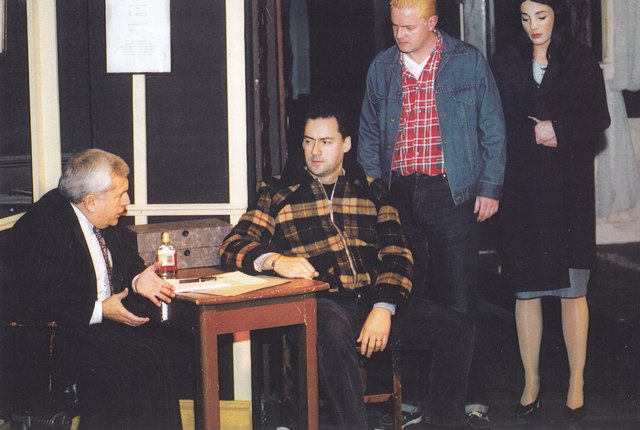
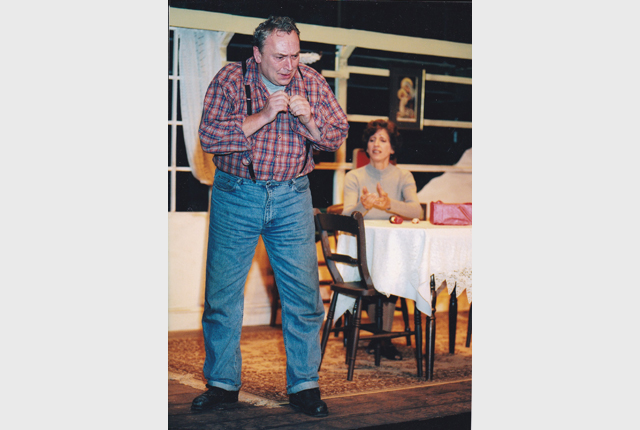
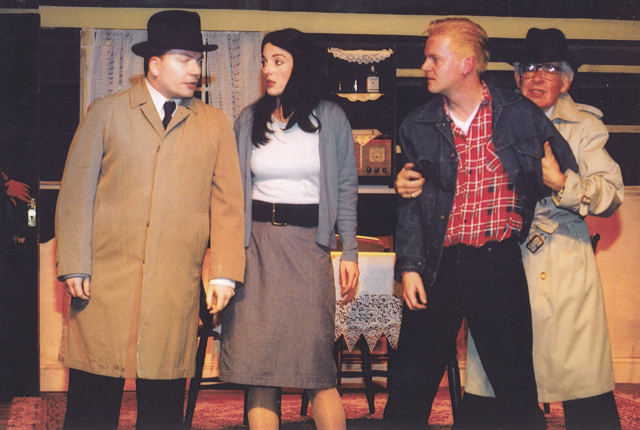
Cast List
Mike : Philip O'Gorman
Louis : Laurence Rampling
Eddie Carbone : Colin Dent
Alfieri : Paul Rutledge
Catherine : Elizabeth Johansson
Beatrice : Despina Sellar
Marco : Harry Reeder
Rodolpho : Dominic Ward
Tony : James Easey
1st Immigration Officer : Steven Hyndman
2nd Immigration Officer : Henry Chester
Mr Lipari : Christopher Yates
Mrs Lipari : Denyse Macpherson
Production Team
Director : Sara Randall
Assistant Director : Martin Buttery
Set Design : Andrew Reeves, Roger Beaumont
Lighting Design : Andy Peregrine
Costume Design : Helen Dudley
Sound Design : Phillip Ley
Stage Manager : Tom Winter
ASMs : Lesley Scarth, Jason Kempster
Lighting operator : Mark Borowski
Sound operator : Phillip Ley
Wardrobe : Maureen Dudley
Set construction : Roger Beaumont, Keith Syrett, Ian Chaplain, John Sole, John McSpadyen, Rachel Lacaille, David Macdonald, Jude Chalk &
members of the cast and crew
In-house review by Richard Pedersen
Richard Pedersen, a Tower member for 12 years, was last
seen giving a rendition of a Scottish accent in
the Frank Smith Room. He was also Polixenes in The
Winter's Tale this year.
The bridge is
Brooklyn Bridge and it loomed over the set of
Sara Randall's production of Arthur Miller's
play. The play is a modern classic and rightfully
deserved its sell-out production. I use the term
classic intentionally; the overtones of Greek
tragedy are everywhere in the play and are hard
to miss. Despite being nearly fifty years old
there is a timelessness about the themes which
transcend period; I have seen far more recent
plays which are definitely "dated".
As with all
tragedy the audience needs to be aware that it
will all end in tears. Strangely enough I was
most closely reminded of Willy Russell's musical
Blood Brothers, where the audience knows from the
start that someone is going to die from the white
outline of a body on the stage. The mood evoked
by the director and her cast left the audience in
no doubt that this was not going to be an easy
ride.
Just as the
bridge loomed over the set, so Cohn Dent as Eddie
Carbone loomed over the action, from almost the
first moment when he leaned over the balustrade
and was picked out by the spotlight. I suppose it
was unfortunate that I knew the play and its
denouement, but my companion was able to pick up
the clues without knowing how it was going to
end. With Cohn Dent's masterful performance you
could see the tragic flaws in a man haunted by
his incestuous (and dare I say paedophiliac)
desire for his niece, whose jealousy is so
suddenly provoked by her love for a young illegal
immigrant.
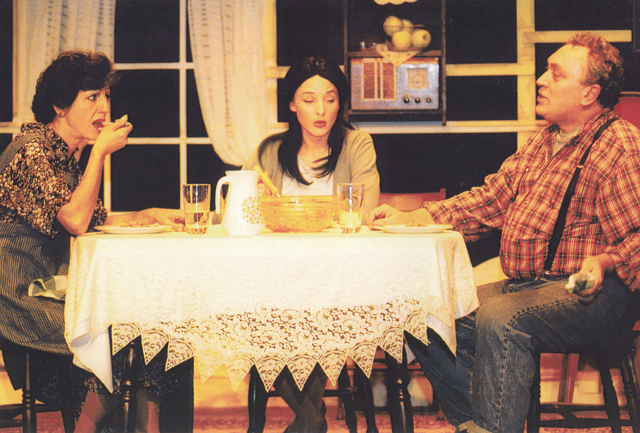
As Eddie's
wife Beatrice, Despina Sellar had the unenviable
task of being downright miserable for most of the
play. She was so believable as the fiery,
passionate woman brought down by years of being
the dutiful spouse in a Sicilian-American
household. The ultimate irony: she was an Italian
mamma with no children.
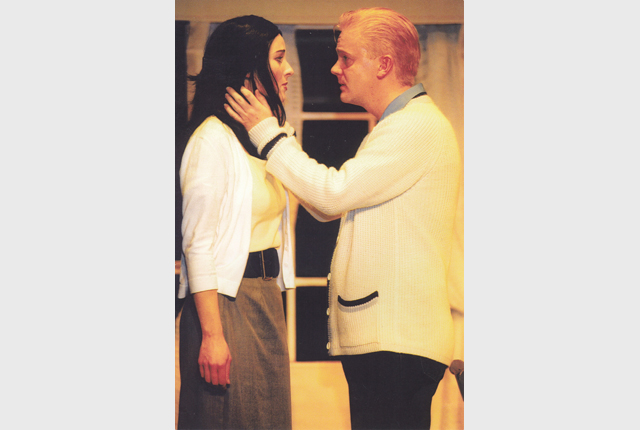
Yet there was
Catherine, her niece and ward, admirably played
by Elizabeth Johansson. She represented the new
generation, American born and bred, anxious to
get rid of the shackles of the old country's
traditions. The actress was a sheer delight to
watch as she revelled in high heels, short
skirts, pop music and the growing realisation
that she was no longer just Eddie's little girl.
I was slightly intrigued that the foyer
photographs appeared to have her in a black wig,
which she had thankfully dispensed with by the
time of performance.
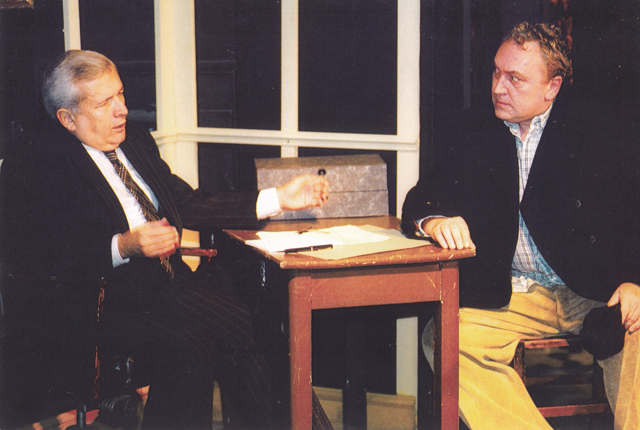
Our narrator,
of sorts, was the lawyer Alfieri, a solid
presence portrayed by Paul Rutledge. He was our
friend and confidant; just as Brooklyn Bridge
connects Long Island to Manhattan, so he
connected the play's action to the audience. It's
a very theatrical device but it worked so well.
Then there
were the two real Italians, Marco and Rodolpho,
"submarines" or illegal immigrants from
poverty-stricken postwar Sicily to the land of
promise in America. Harry Reeder's Marco was a
difficult and rather poorly-written role. His
importance is at the end of the play, but until
then it seemed that Miller didn't have much idea
what to do with him. I felt rather sorry for him
in trying to invest his character with some
modicum of interest, when all he had to do was
look cross or miserable or both, and whinge on
about his tubercular children. As the younger
brother, the blondhaired Rodolpho, Dominic Ward
cleverly managed to portray a person who in
Eddie's words "ain't right". As an
audience we did wonder about his motives in
courting Catherine; was it simply young love, or
was it, as Eddie suggested, merely to get an
American passport? I still cant make up my mind.
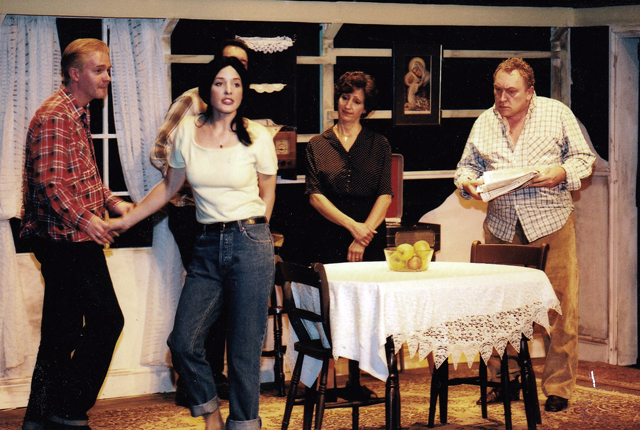
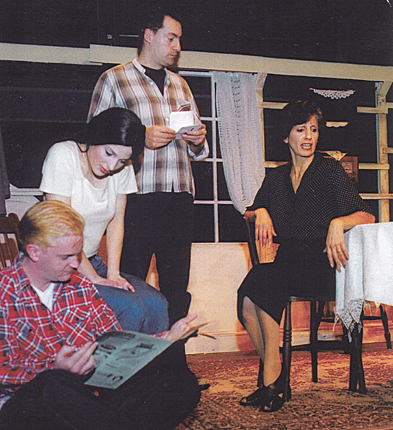
Creating the
set required, on the Tower stage, must have been
a nightmare, so all credit to Andrew Reeves and
Roger Beaumont for managing it so well. My eyes
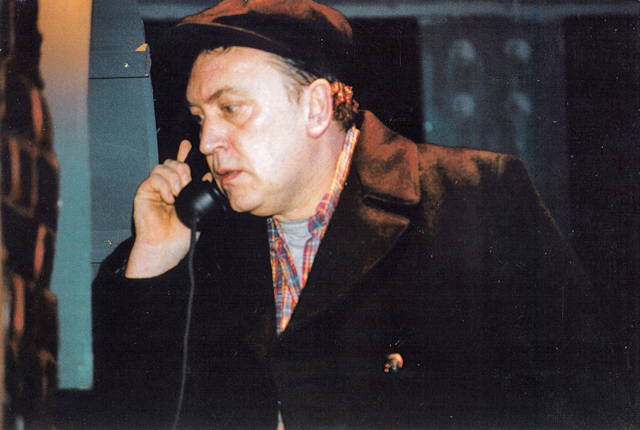
were often fixed on the phone booth, but then I
knew its primal significance. The redbrick wall
was so convincing that my companion opined that
it must have been the back wall of the theatre.
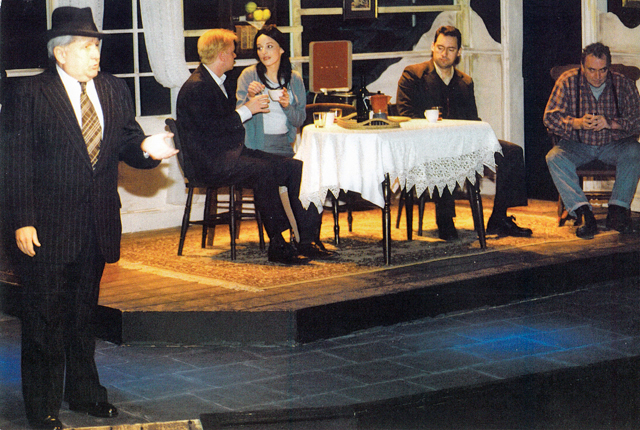
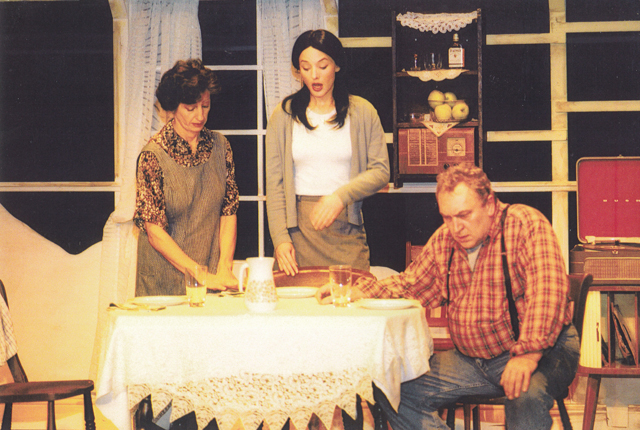
Because the Carbone's apartment was treated as a
separate acting area, I did feel that it
restricted the actors and their scope for
movement, and I sympathised with them having to
cope with that bane of all directors, a dining
table.
Costumes by
Helen Dudley were spot-on for location and
period. Lighting and sound were effective and
faultless.
OK Mr Critic,
so what didn't you like about it? If I'm going to
be picky I could mention some of the accents
which at times sounded a bit more Jackie Mason
than Joe Pesci. Definite traces of North London
were also distinguishable. I felt some of the
blocking towards the end was a bit untidy, and I
thought it was a shame that Eddie had his back to
me when Marco delivered the arch Sicilian insult
of the spit in the face.
The ending of
the play is a problem because Miller courts a
fine line between realism and melodrama. There
were a few suppressed sniggers in the audience
and I can understand why. Eddie's knife in the
fatal encounter looked pathetically small, hardly
capable of delivering a fatal blow to someone of
Cohn Dent's build. I also think that the passing
Priest was a bit unnecessary. And what about the
other two submarines lodging in the attic? Were
they cut as characters because of cast
constraints? Their absence made the presence of
the Liparis a little irrelevant.
'm afraid I
was unconvinced by Henry Chester's Immigration
Officer; his cheery face wouldn't have frightened
a stray cat, let alone two desperate illegal
immigrants. I know it's a small part, but I fear
he wasn't quite right for the role. Finally, I
thought the panto-style curtain call was a bit
over the top for a play of this nature. We really
didn't need to give separate applause to
individual groups of cast. A straightforward
line-up would have been much more in keeping with
the tone of the play.
Still these
are all minor quibbles, some of which may well
have been sorted out by the end of the run. All
in all, A View From The Bridge was a highly
enjoyable production, and the cast and
director(s), and all the associated crew, should
be rightfully proud.
A View from the Bridge
by Arthur Miller |
|
|
October 27th - November 3rd, 2001 |
The Tower Theatre Company performing at the Tower Theatre, Canonbury |
|
Cast List
|
Production Team |
In-house review by Richard Pedersen
Richard Pedersen, a Tower member for 12 years, was last seen giving a rendition of a Scottish accent in the Frank Smith Room. He was also Polixenes in The Winter's Tale this year.
The bridge is
Brooklyn Bridge and it loomed over the set of
Sara Randall's production of Arthur Miller's
play. The play is a modern classic and rightfully
deserved its sell-out production. I use the term
classic intentionally; the overtones of Greek
tragedy are everywhere in the play and are hard
to miss. Despite being nearly fifty years old
there is a timelessness about the themes which
transcend period; I have seen far more recent
plays which are definitely "dated".
As with all
tragedy the audience needs to be aware that it
will all end in tears. Strangely enough I was
most closely reminded of Willy Russell's musical
Blood Brothers, where the audience knows from the
start that someone is going to die from the white
outline of a body on the stage. The mood evoked
by the director and her cast left the audience in
no doubt that this was not going to be an easy
ride.
Just as the
bridge loomed over the set, so Cohn Dent as Eddie
Carbone loomed over the action, from almost the
first moment when he leaned over the balustrade
and was picked out by the spotlight. I suppose it
was unfortunate that I knew the play and its
denouement, but my companion was able to pick up
the clues without knowing how it was going to
end. With Cohn Dent's masterful performance you
could see the tragic flaws in a man haunted by
his incestuous (and dare I say paedophiliac)
desire for his niece, whose jealousy is so
suddenly provoked by her love for a young illegal
immigrant.
As Eddie's
wife Beatrice, Despina Sellar had the unenviable
task of being downright miserable for most of the
play. She was so believable as the fiery,
passionate woman brought down by years of being
the dutiful spouse in a Sicilian-American
household. The ultimate irony: she was an Italian
mamma with no children.
Yet there was
Catherine, her niece and ward, admirably played
by Elizabeth Johansson. She represented the new
generation, American born and bred, anxious to
get rid of the shackles of the old country's
traditions. The actress was a sheer delight to
watch as she revelled in high heels, short
skirts, pop music and the growing realisation
that she was no longer just Eddie's little girl.
I was slightly intrigued that the foyer
photographs appeared to have her in a black wig,
which she had thankfully dispensed with by the
time of performance.
Our narrator,
of sorts, was the lawyer Alfieri, a solid
presence portrayed by Paul Rutledge. He was our
friend and confidant; just as Brooklyn Bridge
connects Long Island to Manhattan, so he
connected the play's action to the audience. It's
a very theatrical device but it worked so well.
Then there
were the two real Italians, Marco and Rodolpho,
"submarines" or illegal immigrants from
poverty-stricken postwar Sicily to the land of
promise in America. Harry Reeder's Marco was a
difficult and rather poorly-written role. His
importance is at the end of the play, but until
then it seemed that Miller didn't have much idea
what to do with him. I felt rather sorry for him
in trying to invest his character with some
modicum of interest, when all he had to do was
look cross or miserable or both, and whinge on
about his tubercular children. As the younger
brother, the blondhaired Rodolpho, Dominic Ward
cleverly managed to portray a person who in
Eddie's words "ain't right". As an
audience we did wonder about his motives in
courting Catherine; was it simply young love, or
was it, as Eddie suggested, merely to get an
American passport? I still cant make up my mind.
Creating the
set required, on the Tower stage, must have been
a nightmare, so all credit to Andrew Reeves and
Roger Beaumont for managing it so well. My eyes
were often fixed on the phone booth, but then I
knew its primal significance. The redbrick wall
was so convincing that my companion opined that
it must have been the back wall of the theatre.
Because the Carbone's apartment was treated as a
separate acting area, I did feel that it
restricted the actors and their scope for
movement, and I sympathised with them having to
cope with that bane of all directors, a dining
table.
Costumes by
Helen Dudley were spot-on for location and
period. Lighting and sound were effective and
faultless.
OK Mr Critic,
so what didn't you like about it? If I'm going to
be picky I could mention some of the accents
which at times sounded a bit more Jackie Mason
than Joe Pesci. Definite traces of North London
were also distinguishable. I felt some of the
blocking towards the end was a bit untidy, and I
thought it was a shame that Eddie had his back to
me when Marco delivered the arch Sicilian insult
of the spit in the face.
The ending of
the play is a problem because Miller courts a
fine line between realism and melodrama. There
were a few suppressed sniggers in the audience
and I can understand why. Eddie's knife in the
fatal encounter looked pathetically small, hardly
capable of delivering a fatal blow to someone of
Cohn Dent's build. I also think that the passing
Priest was a bit unnecessary. And what about the
other two submarines lodging in the attic? Were
they cut as characters because of cast
constraints? Their absence made the presence of
the Liparis a little irrelevant.
'm afraid I
was unconvinced by Henry Chester's Immigration
Officer; his cheery face wouldn't have frightened
a stray cat, let alone two desperate illegal
immigrants. I know it's a small part, but I fear
he wasn't quite right for the role. Finally, I
thought the panto-style curtain call was a bit
over the top for a play of this nature. We really
didn't need to give separate applause to
individual groups of cast. A straightforward
line-up would have been much more in keeping with
the tone of the play.
Still these
are all minor quibbles, some of which may well
have been sorted out by the end of the run. All
in all, A View From The Bridge was a highly
enjoyable production, and the cast and
director(s), and all the associated crew, should
be rightfully proud.