|
 Richard III – the Bard's second longest play (after Hamlet): (in)famous for the villainy of its title character, for many over-the-top performances of the title rôle, and understandable parodies of these – it's one of those compelling pieces where you say, after a bit, “Can Shakespeare really be serious here?”. I think it unlikely he could be so ingenuous, so what we have must qualify as a satire: an attempt to combine all possible physical and personality defects in one scapegoat figure – and to lace the part with ironic humour, shared with the audience through his many soliloquies. Many analyses of this demise of the Plantagenets discredit the contemporary sources Shakespeare drew on as, at best, inaccurate or misleading and, at worst, shameless pro-Tudor propaganda. Evidence is lacking for many of the crimes ascribed to Richard, including (particularly) the Princes In The Tower for which most people 'know' him. Richard III – the Bard's second longest play (after Hamlet): (in)famous for the villainy of its title character, for many over-the-top performances of the title rôle, and understandable parodies of these – it's one of those compelling pieces where you say, after a bit, “Can Shakespeare really be serious here?”. I think it unlikely he could be so ingenuous, so what we have must qualify as a satire: an attempt to combine all possible physical and personality defects in one scapegoat figure – and to lace the part with ironic humour, shared with the audience through his many soliloquies. Many analyses of this demise of the Plantagenets discredit the contemporary sources Shakespeare drew on as, at best, inaccurate or misleading and, at worst, shameless pro-Tudor propaganda. Evidence is lacking for many of the crimes ascribed to Richard, including (particularly) the Princes In The Tower for which most people 'know' him.
 Be that as it may, director Kornelia Adelajda's stated aim is to present Shakespeare's text with emphasis on the humour and a 'skin' of recognisable modern times. Assisted by Ragan Keefer, she has given us an engaging, pacy evening, pared down (as many have done over the years) to a manageable two hours including interval. Be that as it may, director Kornelia Adelajda's stated aim is to present Shakespeare's text with emphasis on the humour and a 'skin' of recognisable modern times. Assisted by Ragan Keefer, she has given us an engaging, pacy evening, pared down (as many have done over the years) to a manageable two hours including interval.
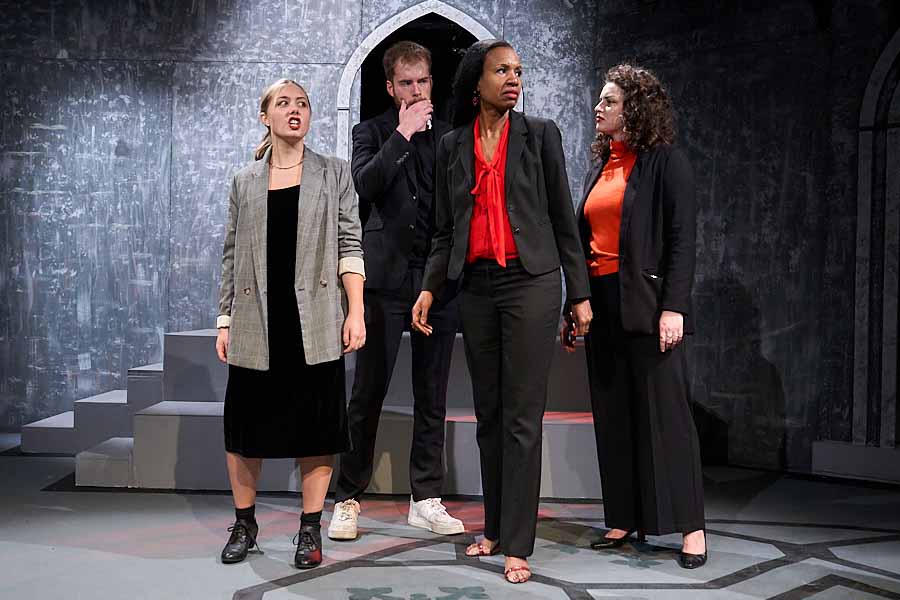
The multi-purpose set (Sara Svati and Jude Chalk) features mottled grey castle walls, simple archways for entrances/exits, and two banks of deep steps to create ledges and points of command. Lighting by Alexander Kampmann, ably operated by Ragan Keefer, provided effective contrasts between moody night musings and stark daylit moments of (often fatal) decision. The occasional changes of scene (and a larger transformation during the interval) were swiftly carried out by cast members and ASM Lucy Moss under Stage Manager Laurence Tuerk. Atmospheric sound (Matthew Ibbotson), and occasionally menacing music choices by the director, arrived smartly on cue from operator Chris Shiel.
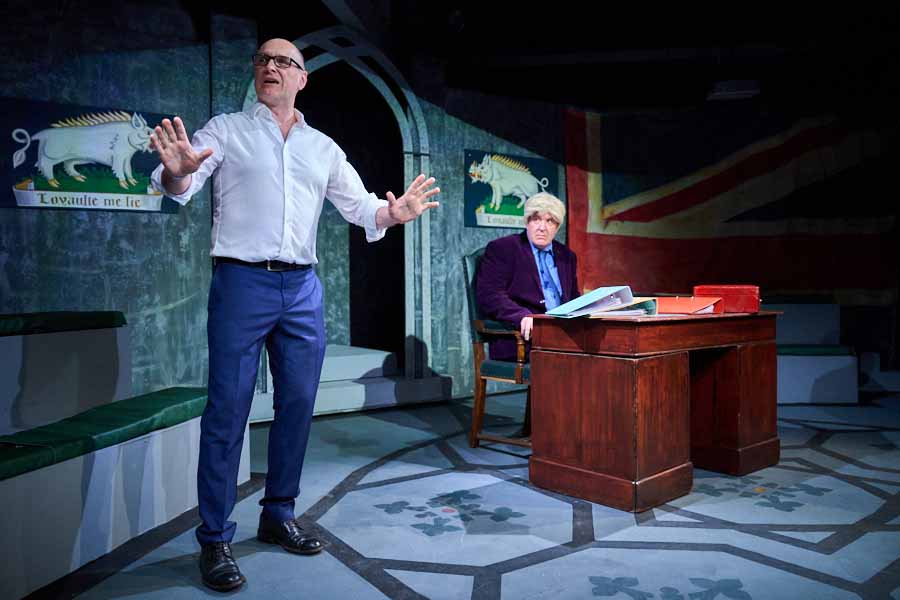 Chris Frawley confidently inhabited the title rôle: discovered before 'curtain-up' dozing at his desk in a modern suit, blue shirt and Boris wig, he springs into the “Now is the winter...” speech with expected relish. I felt that the rhythms of Shakespeare's pentameters were always clear from the cast, though there were occasions when I did not catch all words from two or three of the actors. Frawley negotiated the frankly improbable U-turns of his plotting with plausible smoothness and confirmed (in asides) that the character is well aware of his wickedness and ambition. Whenever he was on stage, there was no doubt who was in charge – even when he was being put through the wringer by either of the Queens or Lady Anne. There was a wide range of moods, from amused irony to assumed tenderness to chilling ruthlessness as, one by one, the obstacles to the throne are removed. His posture was generally round-shouldered and a little stiff, serving as an echo of the more physically handicapped interpretations of other productions. Chris Frawley confidently inhabited the title rôle: discovered before 'curtain-up' dozing at his desk in a modern suit, blue shirt and Boris wig, he springs into the “Now is the winter...” speech with expected relish. I felt that the rhythms of Shakespeare's pentameters were always clear from the cast, though there were occasions when I did not catch all words from two or three of the actors. Frawley negotiated the frankly improbable U-turns of his plotting with plausible smoothness and confirmed (in asides) that the character is well aware of his wickedness and ambition. Whenever he was on stage, there was no doubt who was in charge – even when he was being put through the wringer by either of the Queens or Lady Anne. There was a wide range of moods, from amused irony to assumed tenderness to chilling ruthlessness as, one by one, the obstacles to the throne are removed. His posture was generally round-shouldered and a little stiff, serving as an echo of the more physically handicapped interpretations of other productions.
 The director, standing in at short notice for Queen Margaret, instantly invoked the look and amused awareness of Teresa May as she oversaw the fatal pathway taken by Richard.Landé Belo (Queen Elizabeth) was strong, eloquent and full of outrage at the murder of her sons – neatly and poignantly symbolised by the school ties returned to her from the Tower of London.For me, Matthew Tylianakis carried off the acting honours: instantly recognisable as the Dominic Cummings character (Buckingham) in his glasses and body-warmer, he was every inch the yes-man, the facilitator. Smooth, clear, and quick to spin the changing whims of Richard to the best advantage, he evinced moments of satisfaction that reminded me of Mark Gatiss. His understandable resentment at being deprived of the promised gift of Hereford led to a forthright acceptance of his speedy fall from grace. The director, standing in at short notice for Queen Margaret, instantly invoked the look and amused awareness of Teresa May as she oversaw the fatal pathway taken by Richard.Landé Belo (Queen Elizabeth) was strong, eloquent and full of outrage at the murder of her sons – neatly and poignantly symbolised by the school ties returned to her from the Tower of London.For me, Matthew Tylianakis carried off the acting honours: instantly recognisable as the Dominic Cummings character (Buckingham) in his glasses and body-warmer, he was every inch the yes-man, the facilitator. Smooth, clear, and quick to spin the changing whims of Richard to the best advantage, he evinced moments of satisfaction that reminded me of Mark Gatiss. His understandable resentment at being deprived of the promised gift of Hereford led to a forthright acceptance of his speedy fall from grace.
 Communications were (naturally) generally made by mobile phones – in a couple of cases, well-rehearsed conversations with recorded faces projected on the wall (courtesy of Harry Tomlin) gave a better immediacy to the news – a welcome change from the human messengers stipulated by Shakespeare. Communications were (naturally) generally made by mobile phones – in a couple of cases, well-rehearsed conversations with recorded faces projected on the wall (courtesy of Harry Tomlin) gave a better immediacy to the news – a welcome change from the human messengers stipulated by Shakespeare.
Kevin Furness as Hastings became understandably heated at the realisation of his impending execution; Stephanie Irvine (Lady Anne) negotiated the extraordinarily difficult turnaround from grieving widow, to enraged and spitting accuser, to mollified object of Richard's determined wooing – all in one extended scene! Daniel Watson, as ever, gave good value as Clarence: articulate and reasonable, but haunted by the premonition of his death in a dream; Nick Hall was very affecting as the dying King Edward IV, in a wheelchair with a drip, coughing his last breaths with his attendant lords in protective masks. Simran Dhadda, smartly dressed as a civil servant (Catesby), promptly attended to the increasingly violent requirements of Richard: Nic Campos got my vote for making the most of the small part of Stanley with businesslike crispness of diction and confidence.
 The interval was flagged by a triumphal acceptance of Richard's arrival in the centre of power – drinks all round (Downing Street?) and the adoption of a symbolic purple velvet jacket. The interval was flagged by a triumphal acceptance of Richard's arrival in the centre of power – drinks all round (Downing Street?) and the adoption of a symbolic purple velvet jacket.
On return after the interval, the audience found a huge (and anachronistic) Union Flag covering the two walls of the set – in two halves (symbolic of something?) and a couple of boars, coats-of-arms expressive of Richard's acknowledged elevation from Lord Protector to Monarch. An office desk, complete with ring-binders and 'red box'. The stepped areas against one wall were furnished with long seat-cushions – later to accommodate the ghosts of the dead after their accusations of Richard in his eve-of-battle nightmare, which he experienced on the other plinth, standing in for his Bosworth Field encampment.
 Rita Lieder, Tom Brooks and Rachel Verhoef did sterling service in small parts: minor lords, undertakers, bishops, messengers, murderers – Verhoef particularly striking as a cool and streetwise yobette happy to be involved in assassination. I was sorry not to hear the exchange about the Bishop of Ely's strawberries in Holborn – given that I regularly play cards in a pub just off Ely Place...Norbert Szabo as the fated Edward V, with Natalia or Annika Sampson Flandro as the Duke of York, in school blazers and ties, had a fleeting chance to inspire pity from those of us who think we know what happened to them... Rita Lieder, Tom Brooks and Rachel Verhoef did sterling service in small parts: minor lords, undertakers, bishops, messengers, murderers – Verhoef particularly striking as a cool and streetwise yobette happy to be involved in assassination. I was sorry not to hear the exchange about the Bishop of Ely's strawberries in Holborn – given that I regularly play cards in a pub just off Ely Place...Norbert Szabo as the fated Edward V, with Natalia or Annika Sampson Flandro as the Duke of York, in school blazers and ties, had a fleeting chance to inspire pity from those of us who think we know what happened to them...
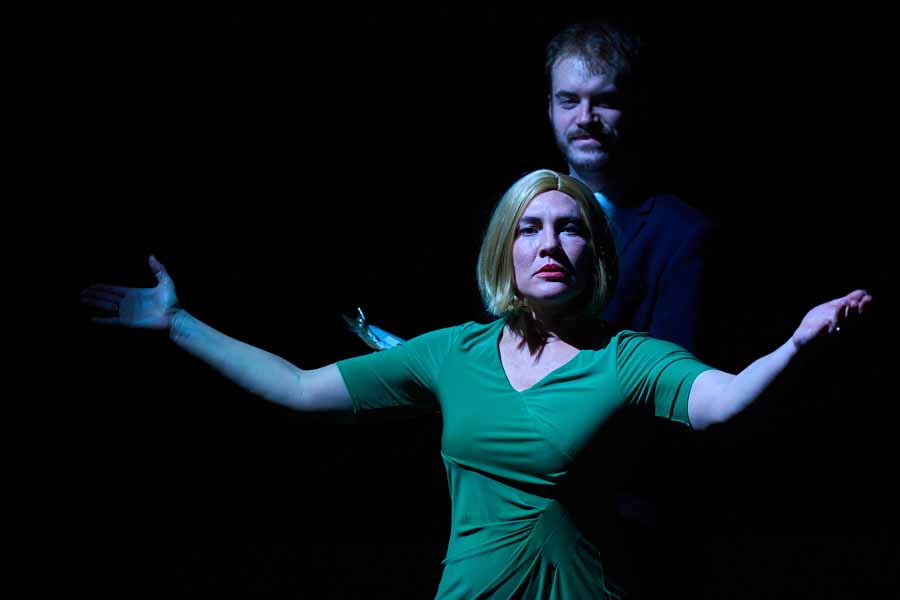
 With the introduction of a couple of lecterns with microphones, Lucy Moss, in a startling sex-blind piece of casting, a clinging bright green dress and a blond wig, presented a well-modulated account of the rallying-cry of the Earl of Richmond to his soldiers, as if it were a speech at a political hustings. Likewise the sneering Richard replied with his corresponding speech – but at the end dropped his head to signify his death – his purple velvet jacket to be removed and given to Richmond as Henry VII.Costume design by Laura Coulton was spot-on – the various 'types' of recent political history all instantly identifiable. With the introduction of a couple of lecterns with microphones, Lucy Moss, in a startling sex-blind piece of casting, a clinging bright green dress and a blond wig, presented a well-modulated account of the rallying-cry of the Earl of Richmond to his soldiers, as if it were a speech at a political hustings. Likewise the sneering Richard replied with his corresponding speech – but at the end dropped his head to signify his death – his purple velvet jacket to be removed and given to Richmond as Henry VII.Costume design by Laura Coulton was spot-on – the various 'types' of recent political history all instantly identifiable.
I felt this production to be a thoroughgoing and consistent translation of time and place that did not detract from the demonizing impact of Shakespeare's original – pace, fluency, confidence were all present in good quantities.
Photography by Jason Harris
|