In 2006, a government sponsored survey confirmed that a cup of tea constituted one of the national symbols of Britain (more specifically England) alongside roast beef and Yorkshire pudding and fish and chips. With the Tower Theatre’s latest production of Janice Okoh's The Gift heavily featuring said beverage, it was entirely appropriate that the first Saturday matinee was preceded by a chance to sip, sup and enjoy a cuppa in the Smith studio. It was a convivial start to what would go on to be an entertaining, challenging and rewarding afternoon’s play going, as well as a potent reminder of the days of Empire, when the taking of afternoon tea became ritualised in British society and which was to feature so heavily throughout this drama. The Gift is Okoh’s third full length play and premièred in 2020, luckily completing just ahead of Covid lockdowns. This production follows on from her piece Three Birds which played at the Tower in autumn 2021; this production further confirmed the writing talent on display. In 2006, a government sponsored survey confirmed that a cup of tea constituted one of the national symbols of Britain (more specifically England) alongside roast beef and Yorkshire pudding and fish and chips. With the Tower Theatre’s latest production of Janice Okoh's The Gift heavily featuring said beverage, it was entirely appropriate that the first Saturday matinee was preceded by a chance to sip, sup and enjoy a cuppa in the Smith studio. It was a convivial start to what would go on to be an entertaining, challenging and rewarding afternoon’s play going, as well as a potent reminder of the days of Empire, when the taking of afternoon tea became ritualised in British society and which was to feature so heavily throughout this drama. The Gift is Okoh’s third full length play and premièred in 2020, luckily completing just ahead of Covid lockdowns. This production follows on from her piece Three Birds which played at the Tower in autumn 2021; this production further confirmed the writing talent on display.
 The play covers off a number of important and serious topics but does so with a good deal of wit and classy comedy which certainly commands an audience’s attention rather more than a preachy polemic would probably do. There are many well-honed individual lines evoking memories of Wilde and Coward but as the settings are various drawing rooms that is almost certainly deliberate. However, I did not find the writing fault free. There were, for my liking, one too many tonal shifts through the three act structure which moved from high social comedy, to the comedy of acute embarrassment and culminated in a somewhat surreal final act strong on flight of fancy and which attempted to draw the various strands together but, for me anyway, did not quite work. Fortunately this classy production tended to dissipate such concerns. The play covers off a number of important and serious topics but does so with a good deal of wit and classy comedy which certainly commands an audience’s attention rather more than a preachy polemic would probably do. There are many well-honed individual lines evoking memories of Wilde and Coward but as the settings are various drawing rooms that is almost certainly deliberate. However, I did not find the writing fault free. There were, for my liking, one too many tonal shifts through the three act structure which moved from high social comedy, to the comedy of acute embarrassment and culminated in a somewhat surreal final act strong on flight of fancy and which attempted to draw the various strands together but, for me anyway, did not quite work. Fortunately this classy production tended to dissipate such concerns.
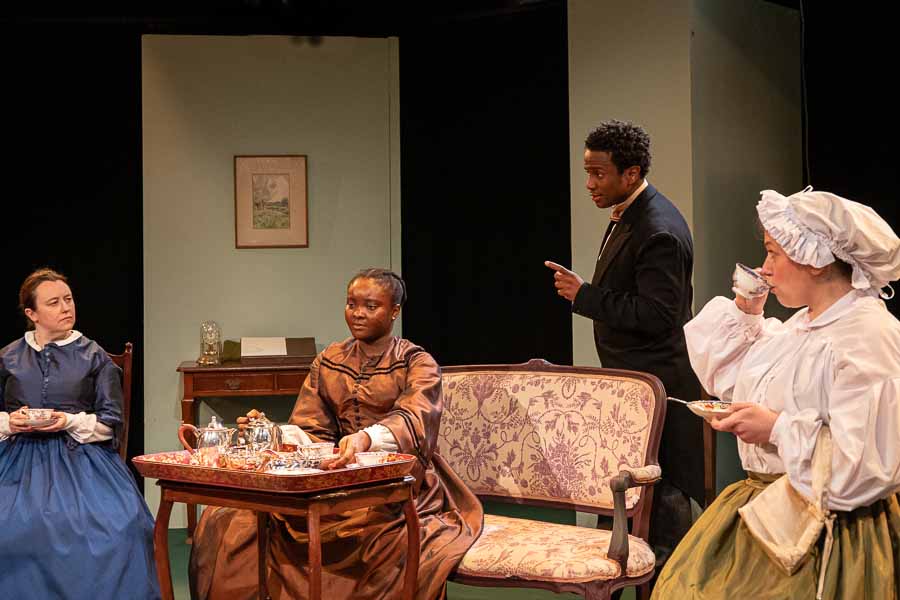 Set in 1862, the modern day and some sort of mash up of the two and moving from Brighton, to Cheshire and Queen Victoria’s royal apartments respectively, the play examines the “gift” of British imperialism with its concomitant legacy of cultural appropriation. This is intriguingly reversed right from the off when we see Yoruba princess Aina (herself gifted to Queen Victoria and repositioned/renamed as Sarah) guiding her maid Aggie through that most quintessential and ritualistic of British pastimes, the preparing and taking of afternoon tea. Sarah is poised and elegant, Aggie is clumsy and gauche and both are attempting to conform in a desperate effort to fit in with the guests that are shortly to arrive. When they do, some tensions are revealed and the audience is firmly reminded that the major concerns of the play are nothing new. Sarah’s background is only sketchily filled in at this point but her history (and, importantly, the play is based on real events) becomes more apparent in aspects of Act 2. Set in 1862, the modern day and some sort of mash up of the two and moving from Brighton, to Cheshire and Queen Victoria’s royal apartments respectively, the play examines the “gift” of British imperialism with its concomitant legacy of cultural appropriation. This is intriguingly reversed right from the off when we see Yoruba princess Aina (herself gifted to Queen Victoria and repositioned/renamed as Sarah) guiding her maid Aggie through that most quintessential and ritualistic of British pastimes, the preparing and taking of afternoon tea. Sarah is poised and elegant, Aggie is clumsy and gauche and both are attempting to conform in a desperate effort to fit in with the guests that are shortly to arrive. When they do, some tensions are revealed and the audience is firmly reminded that the major concerns of the play are nothing new. Sarah’s background is only sketchily filled in at this point but her history (and, importantly, the play is based on real events) becomes more apparent in aspects of Act 2.
 This takes us to the home of a modern day Sarah, a somewhat insecure structural engineer, husband James, who reveals more about the Act 1 narrative, and their adopted daughter Victoria -significant! It provided the highlight of the play as a second tea party virtually forced upon the couple by the arrival of their seemingly (and it is only seemingly) politically correct next door neighbours Harriet and Ben who bear a gift basket of gluten free, nut free muffins. The dialogue in this section is beautifully modulated gradually revealing social discomfort, casual racism and even betrayal. Harriet, in particular, comes out with increasingly outrageous comments even while she clearly considers herself to be a paragon of empathetic virtues; her utterances, not surprisingly, raised some vocal reactions from an incredulous audience. As a piece of satire this section was sharply barbed with (unfortunately) a ring of authenticity – “the weasel under the cocktail cabinet” as Harold Pinter once described such a situation. This takes us to the home of a modern day Sarah, a somewhat insecure structural engineer, husband James, who reveals more about the Act 1 narrative, and their adopted daughter Victoria -significant! It provided the highlight of the play as a second tea party virtually forced upon the couple by the arrival of their seemingly (and it is only seemingly) politically correct next door neighbours Harriet and Ben who bear a gift basket of gluten free, nut free muffins. The dialogue in this section is beautifully modulated gradually revealing social discomfort, casual racism and even betrayal. Harriet, in particular, comes out with increasingly outrageous comments even while she clearly considers herself to be a paragon of empathetic virtues; her utterances, not surprisingly, raised some vocal reactions from an incredulous audience. As a piece of satire this section was sharply barbed with (unfortunately) a ring of authenticity – “the weasel under the cocktail cabinet” as Harold Pinter once described such a situation.
 Act 3 takes the audience back to the 1860s again, but this time to an imagined reality in which both Sarahs reflect on their role in society and the ongoing effects of trying to fit into a world which routinely fails to value their true worth as human beings. There’s another interesting reversal here. Rather than presenting the spirit of the first Sarah to her modern day namesake and having her issuing a call to arms, which would have been the obvious route to take, Okoh turns this on its head and has the latter day Sarah offering guidance and advice to her spiritual predecessor. This culminates in an act which, had it really occurred, would certainly have changed the course of history. The polemic which is carefully downplayed earlier in the play becomes rather more explicit. Perhaps it needed to be but, as already indicated, I found the shift of tone somewhat awkward. Act 3 takes the audience back to the 1860s again, but this time to an imagined reality in which both Sarahs reflect on their role in society and the ongoing effects of trying to fit into a world which routinely fails to value their true worth as human beings. There’s another interesting reversal here. Rather than presenting the spirit of the first Sarah to her modern day namesake and having her issuing a call to arms, which would have been the obvious route to take, Okoh turns this on its head and has the latter day Sarah offering guidance and advice to her spiritual predecessor. This culminates in an act which, had it really occurred, would certainly have changed the course of history. The polemic which is carefully downplayed earlier in the play becomes rather more explicit. Perhaps it needed to be but, as already indicated, I found the shift of tone somewhat awkward.
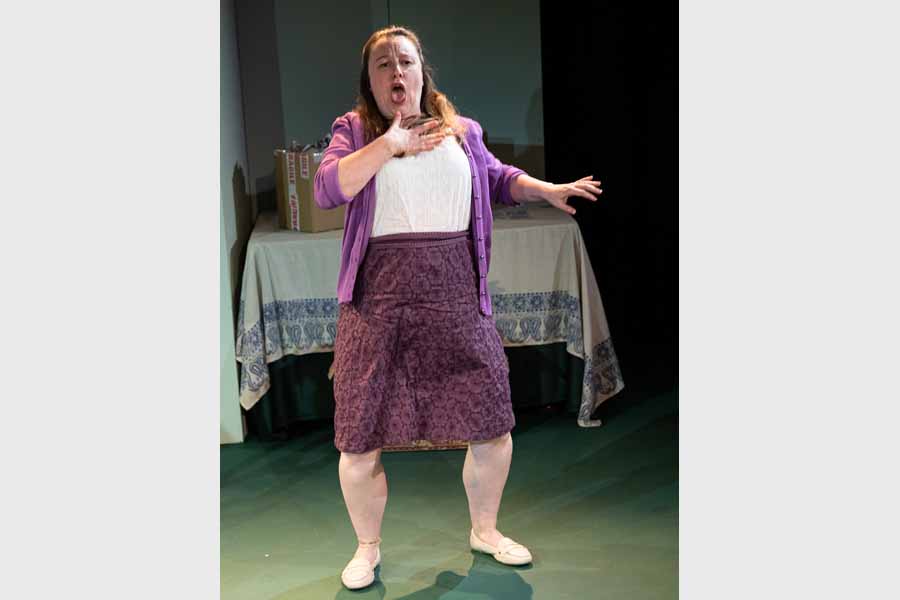
 The cast of six did an excellent job of bringing the eleven featured characters to life – only Megan Madaleine Freeman as Victorian Sarah played a single role and achieved this with a grace and poise making the climax of Act 3, when it comes, even more shocking. Stella Betton as both modern Sarah and Victorian Aggie clearly delineated the pairing and in this single play managed to show that she is highly adept at both the comedy and the serious stuff too. Julia Blyth had great fun as the hypocritical Mrs Waller (a character reminiscent of Dickens) and a robust Queen Victoria. Meanwhile Katie Smith really excelled as the misanthropic Mrs Schoen and a brilliantly conceived and executed Harriet; her ridiculous dance moves in Act 2 were as noteworthily squirm-inducing as those carried out by Ricky Gervais as David Brent in The Office. If the male characters were slightly less well drawn that is no reflection on actors Paulo Vieira and Henry McMenamin who both did what they did with an eye to detail. The cast of six did an excellent job of bringing the eleven featured characters to life – only Megan Madaleine Freeman as Victorian Sarah played a single role and achieved this with a grace and poise making the climax of Act 3, when it comes, even more shocking. Stella Betton as both modern Sarah and Victorian Aggie clearly delineated the pairing and in this single play managed to show that she is highly adept at both the comedy and the serious stuff too. Julia Blyth had great fun as the hypocritical Mrs Waller (a character reminiscent of Dickens) and a robust Queen Victoria. Meanwhile Katie Smith really excelled as the misanthropic Mrs Schoen and a brilliantly conceived and executed Harriet; her ridiculous dance moves in Act 2 were as noteworthily squirm-inducing as those carried out by Ricky Gervais as David Brent in The Office. If the male characters were slightly less well drawn that is no reflection on actors Paulo Vieira and Henry McMenamin who both did what they did with an eye to detail.
 The onstage team were backed by solidly realised contributions from designers Nick Insley (lighting) and Colin Guthrie (sound and music). Laura Coulton’s costumes for the Victorian era were particularly noteworthy and the generally timeless nature and subtle rearranging of the furnishings served well for both eras. Director Landé Belo managed the tonal transitions of each act well and coaxed some excellent performances from her team. However, with tea parties forming the backbone to both the first two sections, the action all became a bit sedentary; fortunately the cracking dialogue and compelling subject matter ensured that interest was not lost. Perhaps Tower should consider completing its Okoh "trilogy" by staging her other full length play Egusi Soup which also examines the experience of the black diaspora. It is also evident from its title that it would indicate another ready opportunity for a further pre show culinary experience. The onstage team were backed by solidly realised contributions from designers Nick Insley (lighting) and Colin Guthrie (sound and music). Laura Coulton’s costumes for the Victorian era were particularly noteworthy and the generally timeless nature and subtle rearranging of the furnishings served well for both eras. Director Landé Belo managed the tonal transitions of each act well and coaxed some excellent performances from her team. However, with tea parties forming the backbone to both the first two sections, the action all became a bit sedentary; fortunately the cracking dialogue and compelling subject matter ensured that interest was not lost. Perhaps Tower should consider completing its Okoh "trilogy" by staging her other full length play Egusi Soup which also examines the experience of the black diaspora. It is also evident from its title that it would indicate another ready opportunity for a further pre show culinary experience.
Photography by David Sprecher
|